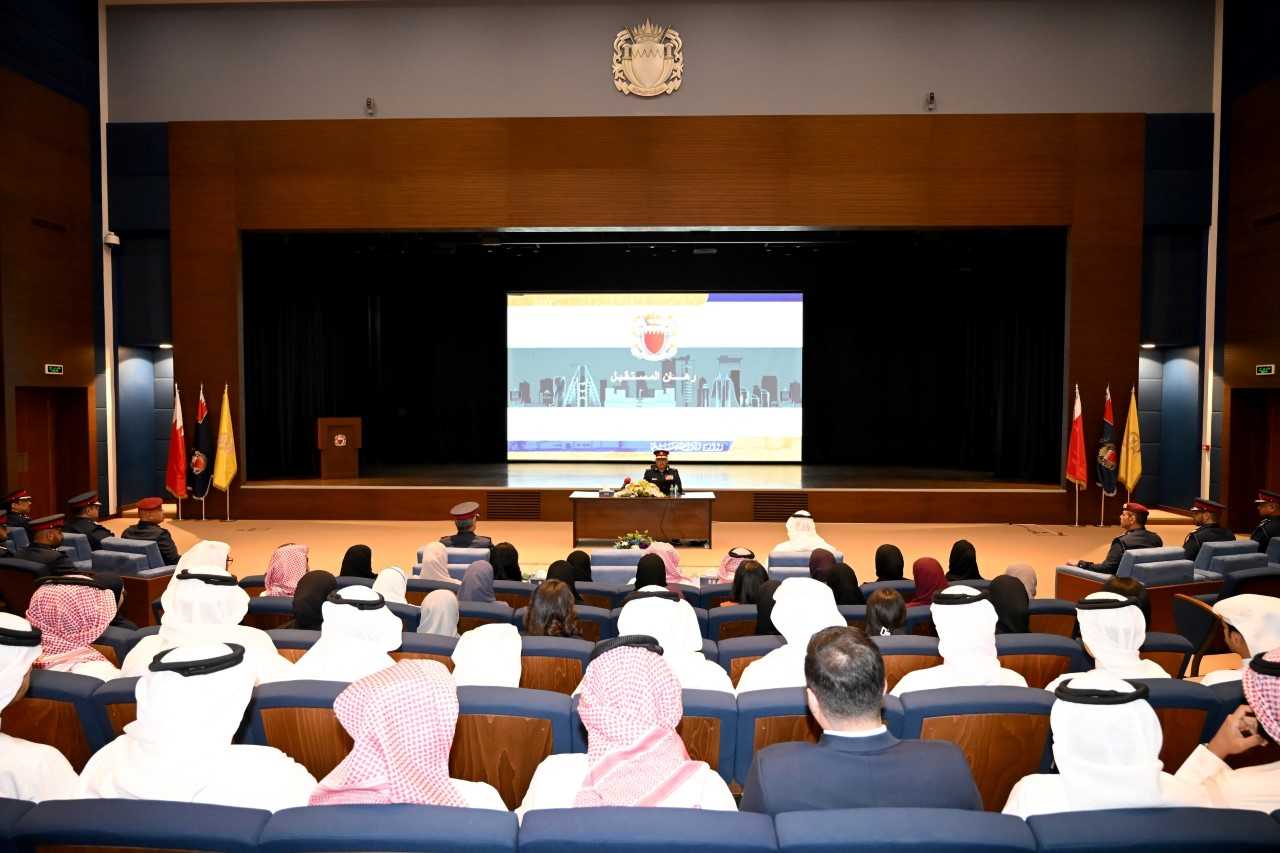
The Chief of Public Security, Lt-General Tariq Al Hassan, affirmed that the progress and opportunities achieved for Bahraini youth stem primarily from the Royal care of His Majesty King Hamad bin Isa Al Khalifa. He noted HM the King’s continuous commitment to placing youth at the centre of national projects, thereby strengthening their role in building both the present and future. He also highlighted the close follow-up of His Royal Highness Prince Salman bin Hamad Al Khalifa, the Crown Prince and Prime Minister, on youth programmes and initiatives across various fields, pointing out that this wise vision has created an environment that fosters creativity and innovation, enabling young national talents to assume influential roles in comprehensive development.
This came during the Chief’s meeting with participants in a dialogue session under the second phase of the “Future Bet 3” programme, organised by the Bahrain Institute for Political Development in cooperation with the Royal Academy of Police.
He praised the attention of His Excellency Interior Minister General Shaikh Rashid bin Abdullah Al Khalifa to empowering youth within the Ministry of Interior by involving them in diverse areas of work and equipping them with advanced training opportunities. He stressed that the Ministry’s modernisation strategy is based on investing in human capital, adopting the latest security technologies, and expanding institutional frameworks to enhance the quality of services provided to citizens and residents. He further noted the adoption of a public security approach, which is anchored in the principles of responsiveness, efficiency, humanity, transparency and accountability, focus on partnership and the introduction of modernised and developed good conduct for police personnel.
The Chief of Public Security underlined that a safe environment is the cornerstone of economic growth, as security efforts to combat crime and protect society are fundamental to attracting investment and supporting national projects. He explained that the Ministry is moving from traditional to smart policing through the creation of a unified smart police platform. The platform, which integrates government and private entities. It analyses, predicts, and extrapolates security incident management, aiming to provide immediate responses and enhance response capabilities using artificial intelligence, event management, and decision-making scenarios. It also aims to increase security levels, protect the rights of citizens, residents, and visitors, improve the quality of services provided, prepare for exceptional circumstances and disasters, and provide early warning of anticipated events.
He highlighted Bahrain’s success in strengthening security, reducing crime rates, and maintaining a stable environment that has positioned the Kingdom among the world’s safest countries for living, investment and tourism. In 2025, Bahrain ranked 16th globally on the Numbeo Safety Index, while CEOWORLD’s 2024 report placed the Kingdom 3rd in the Gulf and 20th worldwide, and Global Finance ranked Bahrain 3rd in the Arab world in 2023.
The Chief pointed to international cooperation as a strategic dimension of the Ministry’s work, noting that exchanging expertise with international security organisations supports national capabilities and bolsters security work through advanced methods to tackle various challenges.
He explained that, within the framework of combating crime and enhancing community safety, the main operations room received more than two million calls in 2025, and operations patrols handled over 130,000 cases. He noted the efforts of the Coast Guard Command in securing the Kingdom's maritime borders and combating illegal fishing and violations that threaten the marine environment and food supplies, in close partnership with the Supreme Council for the Environment. He also pointed to the efforts of the Police Aviation in supporting security, rescue, search and response efforts, as the Police Aviation conducted 195 flights in response to emergencies, in addition to 125 search and rescue flights. He noted the efforts to develop the Police Aviation and provide it with a modern fleet, equipped with greater capabilities and capacities, which contribute to accelerating responses to emergencies and search and rescue operations.
The Chief explained that the National Ambulance Service is a pioneering model that the Ministry is continuously developing, in cooperation and support of the Supreme Council of Health and partntership with health entities such as Health Ministry and the Royal Medical Service of the Bahrain Defence Force, by increasing the number of emergency centres and training medical personnel according to the latest international standards, with the intention of improving response times to accidents and enhancing the quality of services provided to citizens and residents. He noted that work is underway in the near future to provide specialised ambulance services in cases such as heart attacks, strokes, and childbirth.
During the session, the Chief addressed the development of filing cases electronically, which will include all cases in future phases, as well as the launch of smart patrols. Through these patrols, cases will be recorded, processed, and monitored via tablet devices at the reporting location.
The Chief emphasised that the National Civil Protection Platform is a national project aimed at enhancing public safety by providing citizens and residents with information related to their safety. This is based on a methodology that relies on the use of modern technologies and works to enhance the security culture in society. It represents a continuous commitment to employing advanced and modern technologies to raise awareness, enhance community preparedness, and consolidate public security and safety, keeping pace with global changes.
The Chief highlighted the critical role played by the Family and Child Protection Office in enhancing community protection, preventing crime, and providing support to those most in need of care. He emphasised that these efforts complement those of other security directorates to achieve security and stability, preserve national milestones, and promote comprehensive development.
At the conclusion of the session, the Chief expressed his thanks and appreciation to the Institute for Political Development and the Royal Academy of Police for their excellent preparation and organisation. He praised the ideas and topics they included, which contribute to developing the talents and capabilities of young people. He wished the programme participants success.